Lt. George Knowland VC - Magnificent Heroism on Hill 170
Firing a 2-inch mortar from the hip, Lieutenant George Knowland repelled wave after wave of Japanese fighters during the defence of Hill 170 near Kangaw, Burma. For his ‘magnificent heroism’, the twenty-two-year-old commando was awarded the Victoria Cross. Knowland, who had already distinguished himself as a sergeant in Sicily and Italy with No. 3 Commando, was commissioned in June 1944 before joining No. 1 Commando in the Far East during the Burma Campaign.
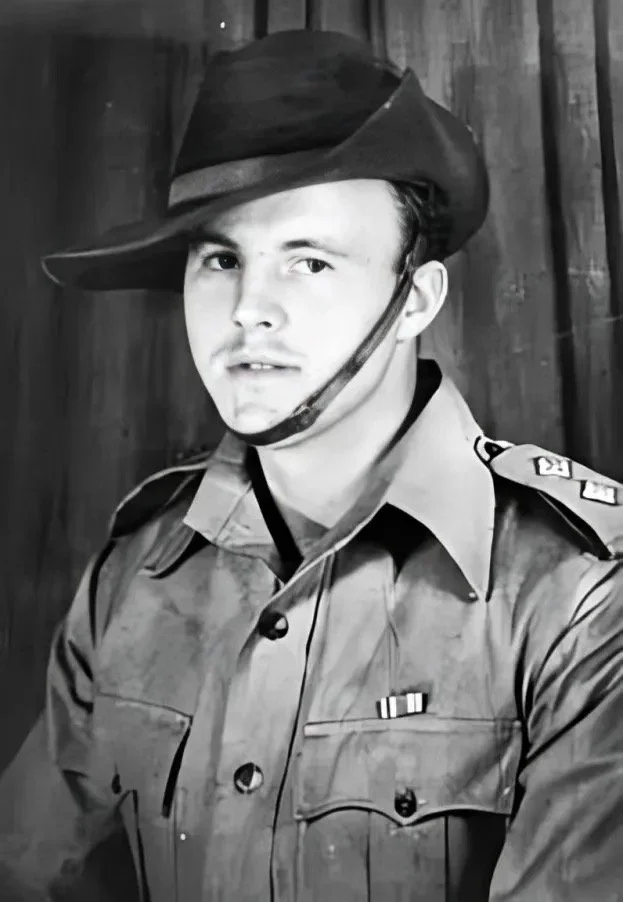
Lieutenant George Knowland VC (Victoria Cross Society)
Landing on the Myebon Peninsula
On 12 January 1945, the 3rd Commando Brigade, consisting of Nos. 1, 5, 42 (RM), and 44 (RM) Commandos, landed on the Myebon Peninsula and quickly captured the village of Kantha. Ten days later, the Brigade embarked on its next mission, involving a five-mile approach up the Daingbon Chaung river in landing craft to cut off the retreating 54th Japanese Division as they withdrew through Kangaw. Their aim, according to the legendary commando leader Brigadier Peter Young DSO MC**, Deputy Commander of 3rd Commando Brigade, was to “exterminate as many Japs as possible.”
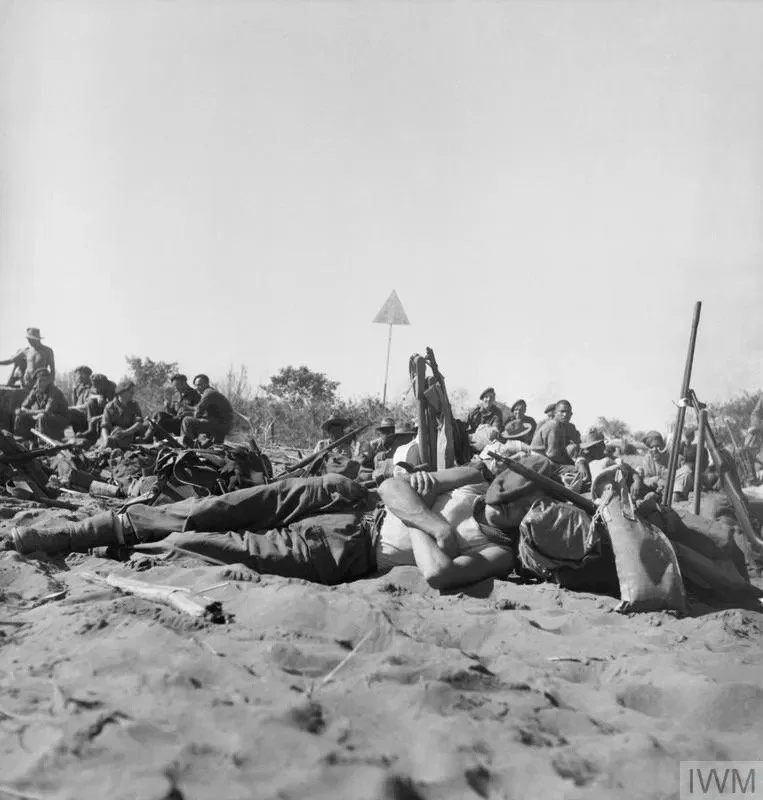
Commandos resting at Akyab before embarking for the Myebon Peninsula (IWM SE 2300)
Securing the Ridge
No. 1 Commando landed at 13.00 hrs on 22 January and immediately set about capturing Hill 170, a long, narrow wooded ridge approximately one and a half miles inland from the river. The ground between the river and the hill consisted of mangrove swamps and was unsuitable for digging trenches, making it vital to the success of the operation that the hill was secured.
With speed and aggression, the commandos attacked from the south and cleared most of the hill at a cost of three men killed and nine wounded. By nightfall, they had secured their position in the centre of the ridge. To the north, Japanese forces were gathering, while Brigade Headquarters and No. 5 Commando lay to the south. Nos. 42 (RM) and 44 (RM) Commandos occupied the flat ground below.
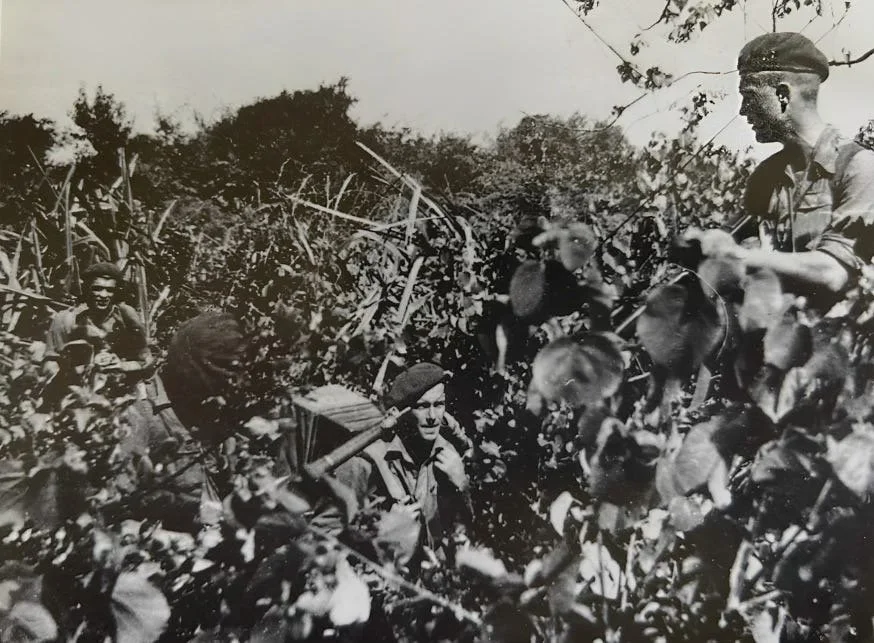
Commandos in the jungle (Royal Marines Museum)
No. 4 Troop Takes the Northern End
At around midnight, the Japanese attacked the two forward troops of No. 1 Commando, fierce fighting ensued but the commandos drove them back. Meanwhile, three troops from No. 44 (RM) Commando attacked and captured the ridge to the east of Hill 170, further strengthening the Brigade’s position.
Following an artillery barrage the next morning, No. 4 Troop advanced over a saddle and secured the northern end of Hill 170. While this move allowed them to dominate the high ground, it carried significant risk. The saddle effectively cut them off from the rest of the Commando and the main body of the Brigade. Nevertheless, despite being subjected to enemy artillery bombardments, they held the ground for days until the Japanese unleashed a ferocious barrage of mortar and machine-gun fire during the early hours of 31 January.
Leadership Under Fire
George Knowland was commanding the twenty-four men of the forward section of No. 4 Troop when the attack began. Despite the intense barrage, he moved among his men, offering encouragement and keeping them alert while under fire himself. When the enemy—estimated to be three hundred strong—launched their first assault, they concentrated their efforts on Knowland’s section. Undeterred by the ferocity of the attack, he moved from trench to trench distributing ammunition, returning fire, and throwing grenades from completely exposed positions.
Manning the Bren Gun
When a Bren gun crew had all been wounded, Knowland sent back to HQ for replacements and ran forward to man the gun himself until they arrived. The enemy was now less than ten yards away and concealed in dead ground. To gain a better firing position Knowland stood on top of the trench and fired the Bren from the hip, successfully keeping the enemy at bay until the wounded men were evacuated. When the replacement crew tried to reach the position, they too became casualties. Undeterred, Knowland continued firing until another crew took over.
The Mortar Fired from the Hip
During a renewed assault, Knowland took over a 2-inch mortar. Despite heavy fire and the close proximity of the enemy, he stood out in the open, and with the improvisation and resourcefulness that had become the hallmark of the commandos, he placed the mortar’s baseplate against a tree and fired it from the hip, killing six of the enemy with his first shot. When he ran out of ammunition, he sprinted through heavy fire to fetch more bombs, before once again firing from the open in front of his position.
Final Act of Courage
When those bombs were expended, Knowland returned to his trench. Still standing, he picked up his rifle and continued firing at the advancing enemy. As the Japanese closed in, he had no time to recharge his magazine and instead seized a Tommy gun from a casualty, spraying the enemy and killing and wounding many. It was his final act. As he courageously stemmed the assault, he was mortally wounded.
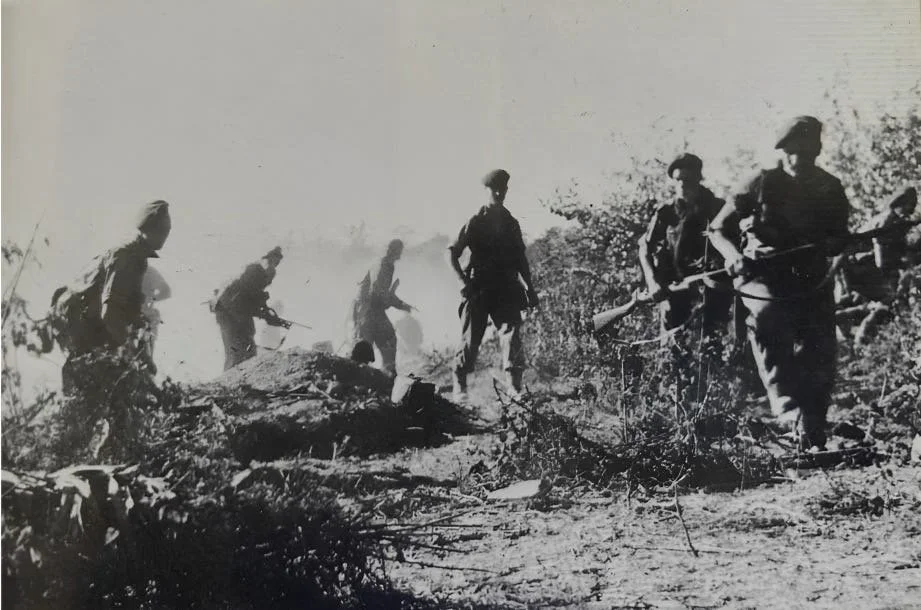
Commandos on Hill 170 (Commando Association / Moreman)
Aftermath and Recognition
The following morning, when the battle was over and Hill 170 secured, Peter Young went forward to examine the ground where No. 4 Troop had fought. “I could hardly move a step without treading on a dead Jap. There were nearly three hundred of them,” he later recalled. George Knowland was among the first commandos he saw, “lying on his back, one knee slightly raised, with a peaceful smiling look on his face.”
Lieutenant George Knowland was posthumously awarded the Victoria Cross, Britain’s highest award for valour in the presence of the enemy. His citation stated that such was the inspiration of his magnificent heroism that, although fourteen of his twenty-four men became casualties at an early stage and six of his positions were overrun, his men held on through twelve hours of continuous and fierce fighting until reinforcements arrived. Had the northern end of the hill fallen, the remainder would have been endangered; instead, the final successful counter-attack was launched from the vital ground which Lieutenant Knowland had played such a gallant part in holding.
After the battle, the commander of the XV Indian Corps—Lieutenant General Sir Philip Christison, Commander XV Indian Corps, stated in a special order of the day to the 3rd Commando Brigade, “The Battle of Kangaw had been the decisive battle of the whole Arakan campaign and that it was won was very largely due to your magnificent defence of Hill 170.”
Legacy and a Stolen Medal
Lieutenant George Knowland VC is buried in Taukkyan War Cemetery, Yangon, Myanmar. Each year, Elmwood School in Croydon, which he attended, holds a memorial service close to the anniversary of his death. The George Knowland Certificate is awarded annually to two pupils who have demonstrated selflessness and community spirit.
However, a sad footnote remains to this incredible story of courage and selfless devotion to duty. In 1958, George Knowland’s Victoria Cross was stolen from a display in his father’s pub and has never been recovered. Anyone with any knowledge of the whereabouts of his medal should contact the police.
Sources:
The London Gazette, Supplement 37027, p. 1939, 10 April 1945
Young, P. (1989). Storm from the Sea. Greenhill Books, London
Moreman, T. 2006. British Commandos 1940 – 1946. Osprey Publishing, Oxford
Burma Star Memorial Fund